
The national plan for housing: Homes for Australia
The dog ate the Minister's homework
Australia plans to spend billions on housing policy. The plan does not tell Australians how that money will be used… or much else about the housing system objectives on which this plan is based.
Last week, Housing Minister Clare O’Neil announced the National Housing Plan (the Plan). It’s the first plan since the National Housing Strategy made in 1983. Leading the effort to develop this plan was a commitment the government made under the National Housing Accord (the Accord).1 Let’s take a look.
TLDR
The trust deficit. The Plan expects Australians to trust supply targets (against a track record of solid and consistent failure), developer incentives and unsourced frames and claims, without showing how those targets translate into adequate, affordable, liveable homes. It offers no concept for coordinating the housing system and shows no basis for confidence that the Minister can lead a program that requires complex systems interaction and reform.
The numbers don’t add up. This plan boasts a $47 billion commitment without a single statement offering where or how that money will be deployed. We show our work in this post. The Plan does not cite sources. Those that can be identified are demonstrated to have been wilfully or negligently mischaracterised.
It relies on trickle-down supply. The research does support the idea that new supply, at any price point and on any terms, adds capacity and eventually frees up homes that can be acquired affordably through moving chains.2 But the Plan uses that premise to abdicate responsibility for directly delivering homes that meet actual market demand.
It expects the private sector will build most of the homes. The Plan fixes its attention on what incumbent developers are willing to deliver, without acknowledging the cost of that approach.3 It follows that the Property Council backed by banks and developers effectively defines the scope of public ambition.
The Accord target is locked in, despite it being unachievable. The headline commitment of the Accord is a promise to deliver 1.2 million new, well-located homes by 30 June 2029. The Plan celebrates the success of the Accord for its planning reforms (read: developer concessions) and on having captured public attention (as if mortgage stress and cost-of-living pressure weren’t already obvious to every Australian, without any need to attach billions of public money in incentive payments for that goal to be achieved). Despite claims that the Plan itself must be kept in a state of ‘constant renewal’, the Accord target (and the funding commitments made in support of it) is fixed, despite recognition that the outcome will fall far short of the objective.4
A far-fetched, unsupported claim: according to the Minister, construction costs have stabilised.5
The slippery language starts in the Minister’s introduction: a $47 billion plan to build a system that “works for all Australians” and aims at supporting “up to” 420,000 new homes over the next ten years. A few things to note:
When the Minister calls affordability fundamental to what it means to be Australian, she frames it relative to incomes and a household’s ability to pay for their homes.
A reader could reasonably infer she understands affordability as a function of what households can actually afford. But trace the statements and sources she relies on, and affordability turns out to be defined by the incentives developers and institutional investors require in order to deliver stock. The Minister’s comments mask the distinction with an unstated assumption that the discounted market rates bring prices to an affordable range for the people paying them.
Even the National Housing Supply and Affordability Council has dropped this pretence and unequivocally declared itself to be a developer advocate on this point.6
The Plan attempts to mask over the bias with doublespeak. The Minister’s position is only defensible if a discount of ~20% to market rates would bring pricing to a level that is within 30% of a household’s gross income.
While the Plan describes responsibility for addressing the housing crisis as a responsibility to be shared between all levels of government, it does not disclose how delegated responsibility will be exercised, or how conflicting biases in these layers of public administration will be reconciled. While national and state/territory layers of government work to avoid recognition that affordability is linked to capacity to pay, at the local government level, the policy position does not reflect developer-friendly arrangements as a guiding policy force.7
The promise that homes be “well-located” did not survive the Accord,8 and isn’t reflected in the results reported so far.9 No commitment to quality, or to actual affordability, has been made.
The recurring assignment of blame to governments of previous decades is the loudest statement made in the Plan. Backed by evasive framing, accountability for the Plan can readily be dodged on the basis that it is expressed on terms that it must be constantly renewed. If public institutions could be trusted, there might be room to accept the framing as dynamic and in need of “constant renewal.” Absent that trust, a more cynical eye looks for the accountability mechanisms that would protect the very real money and land resources being deployed in pursuit of commitments that can be changed (without disclosed principles), and against the constant and growing housing needs of Australians.
The collaborators
The Plan claims to act “from every angle” and points to:
Leadership:
a new dedicated housing function within Treasury;
the National Housing Supply and Affordability Council, whose State of the Housing System 2026 report landed on 30 April (our review of that report and the interests of those who wrote it is here);
an expanded Housing Australia; and
A “dedicated strike team” to fast-track approvals for new home plans10— with no acknowledgement that, under labour shortages and rising supply costs, getting approved plans actually built needs a far broader policy fix.
The Plan claims that action reflects the feedback taken in consultation in “recent” years.11 No consultation or commitment to work with community or citizen advocates in the development of this Plan has been made on terms equivalent to the priveleged access that has been made for Accord parties.12
The reported signals of progress
homebuilding picking up;
improved approvals and commencements (with no mention of stalled work because of constraints attributable to rising supply costs or labour shortages);
250,000 people having used the 5% deposit scheme, counted as an achievement13 (with a stated aim to draw in more via this scheme);
30,000 social and affordable homes in planning, under construction, or delivered;14
stronger rights for renters; and
budget commitments to further housing-supply investment, tax reform, and targeted support for youth homelessness.
Fact check
Proposition: Australia doesn’t have enough homes for its population.
The report is framed on the basis of an OECD average of 468 homes per 1,000 people,15 against Australia’s reported 420 per 1,000 — implying a shortfall of 48 homes per 1,000 people.
The ABS projects a population of 28 million. The 2021 Census counted 10.9 million dwellings; and industry reporting puts the 2025 figure at around 11.4 million.
Run the numbers:
At 28 million people, the plan’s asserted 420 per 1,000 implies 11.76 million homes. We can’t verify that figure. The plan discloses no source for it. We invite the Minister to cite hers.
On the OECD benchmark, 28 million people require ~13.1 million homes. Against 11.4 million existing homes, that’s a shortfall of 1.7 million (or if the Minister’s figure could be trusted, then 1.34 million).
The Plan promises “up to” 420,000 new homes. The Accord commits to 1.2 million new, well-located homes. Together: ‘up to’ 1.62 million new homes (with varying commitment to those homes being “well-located,” and varying integrity to the idea that a home is actually “new” when it is counted toward these targets).
Next, we are asked to assume no population growth at all over the 10 year period that the Plan covers. That’s no natural growth and no increase in migration.16 On the census and industry figures (11.4 million existing homes), delivering the full 1.62 million still leaves Australia short by 84,000 homes (and if we were to trust the Minister’s unsubstantiated assertion (11.76 million homes), the same delivery produces a surplus of roughly 276,000 homes.
So whether the Plan solves the shortfall or satisfies human needs depends entirely on numbers the Plan does not source. That is the whole point. We can’t check the working because the Minister does not show it. Cite the source, and let it be scrutinised. Where we have been able to identify the references used, we have shown how they lack integrity. The Minister must earn the trust of the public. She can start earning that by transparently showing her work.
The Plan also ignores:
sources of supply that don’t serve the interests of banks, developers or investors. Speculative vacancy reports point to a material stock of existing, unused homes. Where dwellings are used for holiday homes they add to the stock number without abating the need for shelter. Genuine policy leadership might include a plan to incentivise the return of unused homes to supply.17
dwellings located in locations which are vulnerable to climate insecurity. Aside from existing stock located in flood zones, heat zones or areas affected by coastal erosion, water insecurity or fire, the location in which new stock is being added appear to be adding to supply in these locations. The Plan does not disclose how many dwellings are expected to be lost or unlivable on this basis.
Proposition: Home ownership is less affordable mainly because supply hasn’t kept pace with demand, pushing up prices.
Developers (and their investors) are rewarded for delivering new supply. A framing that ignores every other driver of unaffordability betrays its bias.18
The dynamic is at least as well explained by housing being primarily characterised as a financial asset, priced by credit, interest rates,19 and tax-driven investment demand, rather than by the physical scarcity of dwellings and human need for shelter. The Reserve Bank’s own modelling found that low interest rates explain much of the rapid growth in both prices and construction.20 The tax system reframes the question entirely: it’s about who the system invites to bid for homes — leveraged investors chasing capital gains — not how many homes exist.
The omission matters. A Plan that treats supply as the dominant explanation for unaffordability avoids the political economy of housing: the tax preferences, credit settings and electoral incentives that reward governments for sustaining high prices. Without that account, the Plan risks presenting unaffordability as a planning failure alone, rather than as the predictable result of treating homes as investment assets before places to live.
Proposition: Investor activity has made it harder for first-home buyers.
The budget’s proposed tax reforms target individual investors. What they ignore are the settings that make residential property compelling for institutional capital who, without policy constraint, would continue to act in competition with Australians seeking to buy a home.
This policy issue calls for nuance. The Accord recognises that it needs institutional capital to fund new development. Any incentives to be distributed must be carefully balanced between targets (Australians who could benefit from support in obtaining a home, or institutions considering investment opportunities in the sector, and who have opportunities outside the sector which do not attract this public backlash).
Proposition: The public housing shortfall stands at 190,000 homes.
The government provides no citation for this figure. We invite the Minister to cite her source.
Independent studies suggest the unmet need exceeds the quantity used in preparing this plan. Mission Australia reports that the number of households on the waiting lists for social housing across Australia is at 224,326 (2024).
Proposition: Reforms to the Environment Protection and Biodiversity Conservation Act 1999 will streamline assessment pathways and speed up approvals while maintaining strong environmental standards.
We invite the Minister to disclose the actual scope of the streamlining.21 Construction-industry participants are signalling expectations that go beyond merely removing duplication.
There’s also been much discussion of states taking over planning approvals on terms that would limit local councils’ ability to weigh neighbourhood sensitivities. The plan doesn’t disclose the zoning or planning model it envisages. But when neighbourhoods lose the ability to shape the population that keeps them viable and liveable, the planning system has failed.
The YIMBY/NIMBY upzoning rift would benefit from thoughtful planning solutions. The hint to centralised planning control at state or territory level would suggest that neighbourhoods being pleasant and viable will not be considered in the Plan.
Proposition: Freezing changes to the National Construction Code 2025 will maintain “strong” safety and quality standards
The freeze pauses measurable improvements to how homes perform. It carves out changes for waterproofing and water-shedding which are acknowledged as necessary for defect management.
Voluntary embodied-carbon provisions were downgraded to guidance. The updated NCC’s energy-efficiency standards are discarded. The cost figures driving the freeze originate largely with the property and building lobby that pushed for the pause, while externalising the long-term consequences onto the people trying to make these buildings comfortable to live in.
The Plan does not define what ‘strong’ safety or quality standards mean.
Proposition: Affordable housing is typically rental housing offered below market rent, with rates set against median incomes or market rents to balance development feasibility against stable, affordable, predictable rents.
The reader is quietly asked to accept that where a “discounted” market rent still exceeds an affordable share of income, a choice will have to be made. When pressed, the government and its advisers on the National Housing Supply and Affordability Council side with developers.
“Affordable housing” in their practice, means the temporary discount to market rent a developer will commit to in exchange for planning concessions. That’s despite the planning instruments they use presenting a different starting point.
Contrast the Minister’s evasive misdirection, with Canada’s policy commitment to affordability:
No hard-working Canadian should have to spend more than 30% of their income on shelter costs. No Canadian should have to live without knowing they have a safe and affordable place to live.
For a home to be decent, it needs to be affordable.22 New Zealand makes policy based on this principle.23 We could do it too. The Minister has chosen not to. This principle has legal foundation. Article 11 of the International Covenant on Economic, Social and Cultural Rights frames it: everyone to an adequate standard of living for himself and his family, including adequate food, clothing and housing, and to the continuous improvement of living conditions.
Proposition: Expectations for the quality of homes are set.
The Social Housing Energy Performance Initiative aims to address thermal comfort and energy security in existing public housing stock. While the Plan abandons commitments to upgrade the NCC to mandate thermal comfort standards for dwellings generally, and says nothing about the state of dilapidation of public housing stock beyond these energy performance factors, the Plan makes unspecified commitments to “strengthening governance, regulation and sector capability” without disclosing what the expected standards actually are or whether housing industry representatives calls for reduced buyer protections will be treated.24
The standards required for modern methods of construction (prefabricated homes) is expressed to be voluntary.
What the plan doesn’t acknowledge:
A rushed, poorly regulated design-and-construct model where cost-cutting starts early and ill-trained and over-worked tradespeople produce substandard work that has to be redone or concealed is reported across the sector.25
An insurability, bankability and security crisis is building for homes in flood plains, urban heat zones, and other areas exposed to adverse climate conditions.26
Public-housing energy upgrades aside, other conditions go unaddressed: whole-of-home ratings for new and existing homes, public and private; and the public-health issues raised about ventilation and mould and general disrepair.
Postponed analysis
We’ll fact-check these claims in a separate review:
planning claims (the National Planning Reform Blueprint delivers more homes)27
the tax claims (reform will help 75,000 first-home buyers into the market)
Programs to close the gap on Indigenous housing are dwarfed by the scale and scope of the problem. While the Minister has included a case study of one comfortably housed indigenous Australian, it makes no mention of the:
the community led initiative to provide thoughtful housing for indigenous Australians, many of whom live in housing that is unbearably unfit for purpose.
litigation being brought against government on the basis that housing lacks basic thermal protections like adequate insulation, shading and air conditioning.28
The claim to be maintaining “fit-for-purpose” homelessness support is troubling, given the plan does not disclose what it recognises to be the scale or scope of homelessness affecting Australians.
Each of these segments of the housing system is itself material and we will come back separately to address them.
New modalities
The Plan leaves room to explore emerging housing models but it does not disclose the regulatory safeguards that would protect participants’ rights in these institutional relationships. The new programs presented in the Plain suggest that the policy envisions increasing:
Build to rent. Pitched as a vehicle for renter stability.29 The plan references build-to-rent tax incentives without saying what they are. Whatever they are, they come at the opportunity cost of incentives that could instead help aspiring owners realise home-ownership goals. The UK’s experience suggests build-to-rent can improve security of tenure, but it’s unclear whether it lowers rents and the Plan offers no thought leadership to support any expectation of genuinely affordable rental stock or how this system will be incentivised (relative to support schemes to encourage ownership).
Long-term rentals. The Plan does not disclose whether renter’s rights will be expanded to reflect the expectation of long-term rentals.
Shared ownership. Public funds covering up to 40% of a home’s cost, for up to 10,000 homes a year from 2026–2029.
First-home-buyer reservations. 100,000 homes set aside specifically for first-home buyers.
The Plan offers no policy leadership on approaches which would separate land value from dwelling value. Community land trusts offer one structure that could serve this purpose. The Minister has elected not to develop a plan that would address the contribution of rising land values as an affordability factor.
Tax reform
For all the legitimate criticism of a personal tax system that incentivises individuals to pursue residential property as an asset class, removing those settings in the absence of broader investment reform simply clears the field for institutional capital to buy homes as investments instead. Any such reform has to reckon with an awkward fact: relative to infrastructure and other asset classes, housing underperforms. It will take thoughtful leadership to design investment settings that attract capital without undermining the actual objective delivering homes for Australians. The Minister will need to disclose whether home ownership is a priority - or whether her Plan depends on Australians accepting tenancy status in a system that feeds stock to institutional portfolios.
Questions for the Minister
How does this Plan allocate the $47 billion investment commitment?
How much money was paid to consultants for services provided in connection with the development of the Plan? How much of the $47 billion is earmarked for consultants?
Where can we find sources for the data upon which the Plan relies? We intend to fact-check every claim. Do you expect Australians to make freedom of information requests to obtain the most basic disclosures to verify the claims made in the Plan?
Why support the $3 billion New Homes Bonus incentive payments to states and territories that hit their Accord targets when your own advisers at the National Housing Supply and Affordability Council have told you no state or territory except the ACT can achieve them?30
Active stewardship (a genuine “constant renewal” of your spending commitments) would suggest that the bonus be set relative to actual performance and be adjusted downward to reflect the shortfall. Those funds could be thoughtfully redeployed to the adjusted plan.31
The Accord commitment was to develop the Plan in collaboration with the local government authorities, institutional investors and construction industry representatives. Have you reflected feedback from these groups in your Plan? No disclosure of the factors relevant to their interests is disclosed in any verifiable form. Have you made private commitments that have not been disclosed in the Plan?
What population projections and assumptions have been adopted in developing this Plan?
Your advisers advise (and market data should tell) you that material constraints come from materials costs and labour supply. Your plan addresses neither.
Why do you ignore the role of debt finance in planning for a housing system that “works for all Australians”? Are you resigned to taking dictation from the banking sector on systemic reform?
The Plan says regional Australia suffers workforce shortages. On what basis? When banks like Westpac promote regional areas as suitable for their target “responsible lending” mortgage book, how do you expect Australians willing to relocate to remote regions to find employment (even if other social factors even make relocation viable)?
What are the parameters of the Productivity Commission’s mandate to assess how regulation affects construction productivity, identify best practice, and recommend reforms to get more homes built quickly? Specifically, will it be mandated to consider:
whether homes are delivered against residents’ capacity to pay for them;
a minimum standard of comfort;
the environmental impact of how homes are built?
The plan acknowledges the opportunity to modernise, but overlooks advanced robotics in housing delivery particularly the technologies being unlocked overseas (for example: Zuru). If you do see the potential of modern methods of construction: why ignore offshore capabilities that exceed our own? Is it because unionised construction labour does not stand to benefit from the adoption of these technologies?
Why is the proposed certification scheme for modern methods of construction voluntary?
Will homes reserved for first-home buyers be resaleable on the open market at market prices? If so, do you accept the lesson of Thatcher-era privatisation — that on resale, the buyer’s discount is captured privately, without easing the underlying housing need? If not, what are the constraints?
Will shared-equity homes carry conditions on sale? If so, what are they?
Do you have a plan to deliver permanent (build-to-rent) rental stock that’s balanced against demand for affordable homes available to aspiring owners? If so, what is it, and how are incentives allocated?
“A Better Deal for Renters” promises minimum rental standards — clear expectations on safety, habitability and essential services. What exactly are those expectations? Freezing the 2025 NCC implies the thermal-comfort expectations in the 2026 NCC are not part of what counts as a home fit to live in. The plan’s actual commitment is only to “phase in” minimum quality standards for rental properties.
The Plan does not mention land assembly. The National Housing Supply and Affordability Council has used two of its reports to propose that governments use their powers of land assembly (including compulsory acquisition) to assemble land parcels that developers wish to obtain, but cannot acquire in the private market. Has the Minister considered these recommendations? Will the public be informed of the status of this recommendation? Will government use public powers of compulsory acquisition to deliver land parcels to developers?
Rider Levett Bucknall forecasts that construction costs will rise 4–6% nationally in 2026, and has warned of further increases as the Middle East conflict drives up fuel, oil and copper prices. Yet the Plan presents a post-COVID fall in construction prices as evidence of progress, relying on lagging ABS data that pre-dates these pressures. It neither acknowledges the rising-cost forecasts nor offers any leadership to address them. On what basis should Australians trust the Government's competency to deliver on its commitment to lead the effort to make a national housing and homelessness plan when it does not acknowledge the material constraint that rising costs represent?
What is your vision for housing in Australia? Does the Government still accept that a decent home is a right rather than a commodity? As we read it, the Plan rests on offering developers incentives which leaves the level of profit, and therefore the price and supply of homes, in the hands of the developers. In turn, that depends on Government to subsidise the gap between market and affordable pricing. There is no recognition of the role the banks play in setting the frame for the housing market. In 1944, the Commonwealth Housing Commission, whose report became the foundation of the Chifley government's postwar housing program, set a very different starting point:
We consider that a dwelling of good standard and equipment is not only the need but the right of every citizen—whether the dwelling is to be rented or purchased, no tenant or purchaser should be exploited by excessive profit. — under Ben Chifley’s leadership
The ‘renewed’ plan
The Plan is flawed because it rests on an exercise of ministerial responsibility that lacks democratic legitimacy. Given this starting point, we agree with the Minister that the Plan requires renewal. Let’s start now.
An effective Plan should start with clear objectives. The Minister has preferred to placate the people depending on her work with evasive language that does not reconcile against the formal instruments that guide the housing sector in practice.
The UN playbook sets out principles for developing housing strategy.32 The Minister has chosen not to use it.
In 2024, Kylea Tink and David Pocock introduced a bill requiring governments to develop, implement and maintain a 10-year National Housing and Homelessness Plan in line with legislated objectives, including improving housing supply, affordability and ending homelessness. At its heart is the goal of
ensuring everyone in Australia has an adequate home. It proposed the appointment of a consumer advocate to represent the people who have housing needs when making these plans. It went nowhere. We’ll start by reviving it.Transparency will be necessary for trust. Canada offers a case study in publicly tracking progress. We will reconstruct this tracker against publicly available (even if we apply for freedom of information disclosures from the Minister’s office for each claim she has made). We will invite the Minister to recognise that the ‘whole of system’ metrics proposed by the National Housing Supply and Affordability Council in its 2026 report have some blind spots.
We’ll help the Minister with the “renewal” and we’ll do it in the commons. Stay tuned for the next post, where we set out how we will assist the Minister in delivering an effective update to her housing plan.
The Accord commitment was for Commonwealth government to lead the development of a National Housing and Homelessness Plan. Local governments, institutional investors and construction industry representatives committed to engaging in the development of the Plan. The Plan does not acknowledge the contributions or evidence the support of its Accord participants for this Plan.
The chains of moves (or filtering policy) resulting from new supply free up both for-sale and rented dwelling units that are then occupied by households across the income spectrum, and provide higher income households with alternatives to the older units for which they might otherwise outbid lower income.
When affordable units sit inside expensive new developments, they cost more per unit than older stock, and the cross-subsidy requirement may itself inhibit building to some degree. Alternatives could deliver substantially more affordable units in high-opportunity neighbourhoods than inclusionary zoning programs do when they are located in developments that are designed by developers who are not constrained by public policy interests (and who are able to access public assets for presales guarantees when the market does not respond to their projects).
We reviewed the State of the Housing System 2026 report here. This Council is mandated under the Accord to advise goverments on the Accord target.
If you’re looking for it, the Plan claims:
Meanwhile, construction costs have stabilised: from annual growth of 17.3 per cent in June 2022, to 2.5 per cent now. - page 21
The Minister has not cited sources in delivering the Plan. We assume she is relying on the ABS Producer Index in making this claim to progress. It represents an annualised lagging measure that captures the easing of the post-COVID peak rather than what's happening at the supply coalface now. Accelerating increases in pricing are expected. The Plan does not acknowledge them.
The peak construction industry bodies representing the sector (Master Builders Australia, Housing Industry Association, Property Council of Australia) are party to the Accord. The HIA cites a Cotality report:
Persistent growth in construction costs is another factor in Australia’s housing shortfall and affordability challenges. The cost to build a house rose another 1.0% in the December quarter, pushing building costs more than 30% higher over the past five years.
According to the builders on the front line, construction costs have not stabilised.
A notable absentee from the consulted stakeholders: the people depending on the Plan to deliver them homes.
The National Housing Supply and Affordability Council released its State of the Housing System 2026 report a few weeks ago. We shared our review here. As of 2026, the Council defines affordable housing directly, without qualification. It openly adopts the definition advanced by developers, whose incentive is to model the financial cost associated with discounted market rents on some of their stock (for 15 years), relative to the ‘bonus’ development rights such as increased height tolerance or dwelling limits they are granted in exchange for providing the discounts.
Contrast this direct and open expression of priority for the developer perspective against the laws on the books and the plans published by state and territory governments.
Take for example, the Inner West Council (NSW) Housing Policy, which defines affordability by reference to a household’s capacity to pay for the essential costs of living.
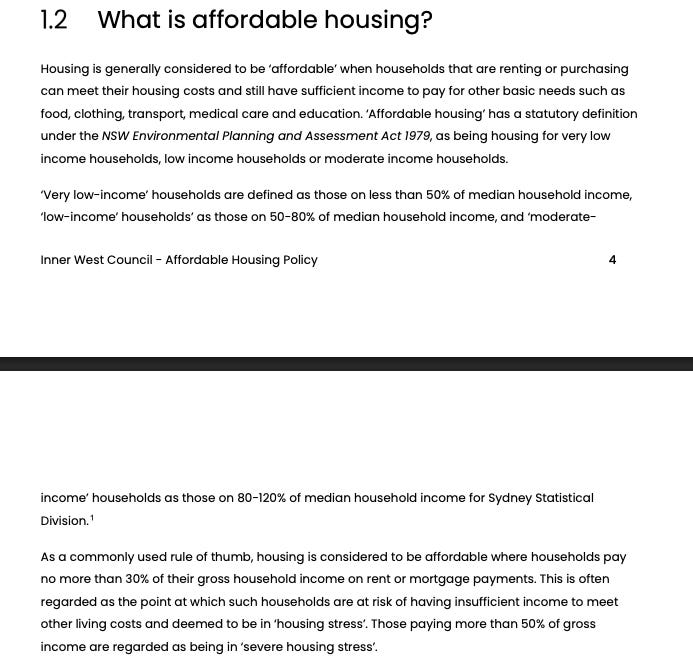
Whilst location considerations don’t make it to the stated goals, hints that it is a desired housing attribute are speckled through the document. For this reason, we read the plan as deprioritising the externality of long and expensive commute times for those who will be dependent on this plan to deliver housing outcomes.
Example:
A stronger housing system means more well-located homes across the spectrum, including social and affordable housing for people who would otherwise be pushed further from jobs, services and opportunity. - page 12
The plan does not cite its sources. The Plan claims that 660,000 “new homes” have been delivered since the Albanese Government came into office. The absence of the “well-located” attribute is implied to convey that the climate vulnerability of homes are located in urban heat deserts, flood-zones is not a consideration, nor those situated in locations that require lengthy and costly daily commutes.
The Plan does not disclose whether planning and zoning changes will reflect advice from its Accord partner that correct sizing, zoning, and airflow planning help avoid costly changes after handover - or if instead, the Government intends to externalise these costs to people trying to live comfortably in those homes.
Buried amidst the density of the word salad is a suggestion that the Department of Climate Change, Energy, the Environment and Water has built this team to accelerate approvals.
Until this announcement of this Plan (last week), the Treasury website for the plan showed no progress on this plan since the consultation ended in 2023. The National Housing Supply and Affordability Council chose not to address the stalled progress in its annual reports. The Plan does not acknowledge the significant rise in the cost of materials since 2023.
In 2024, Kylea Tink and David Pocock introduced a bill which proposed:
the National Housing Consumer Council to advise the Minister on the effectiveness of the Plan; and
a National Housing and Homelessness Advocate to independently monitor the progress of the plan and to undertake reviews into systemic housing issues.
It is claimed that more than half of first home buyers are now entering the market with government support.
When the Minister says ‘delivered’ the word disguises the use of public funds to compete with private buyers in the market for the purchase of existing homes (as opposed to building a new home to add stock to total supply).
For example, in NSW, the 2024/25 annual report, describes funding being provided to community housing providers, so that they could lease 5,940 properties in the private rental market, to make them available as affordable housing to eligible renters. Interventions of this kind put private renters in direct competition with government funded lessors for a significant quantity of rental homes. Whilst the private sector reliance of the public sector for social housing is acknowledged, in the absence of a disclosed plan, the government unfairly reduces the capacity of private market participants to seek housing themselves.
The key findings of the 2024 OECD report suggests there are ‘roughly 468 dwellings per thousand inhabitants’ across OECD countries. On its own terms, the metric is subject to caveats that have been wholesale ignored in the Plan. The count of dwellings assumes that dwellings are occupied. The Plan does not address homes that are not used for housing should be factored into quantity targets it sets.
This metric was popularised in Abundance (whose authors have since acknowledged the blind spots in its scope)… and as Brian Chesky observes:

The Plan acknowledges that an extra 116,700 workers are required to meet the Accord target. If these are to come through migration pathways, the additional population numbers must be acknowledged. The plan suggests 4,000 skilled trade workforce placements annually will be facilitated through its plan - but does not disclose how these migrants will be housed.
We don’t accept this as a genuine expectation as to population growth (attributable to migration or by natural growth).
The 2023 Migration Strategy (published by the Minister in her capacity as Minister for Home Affairs) outlines generic principles. The forward looking statements made in the Migration Strategy are platitudes lacking specific commitment to the size of the population that the Minister considers that Australia can support with essential services, including housing.
We looked at programs which facilitate the return of unused homes to supply in other parts of the world. Recognising that homes are required for shelter creates space to host a national discussion about balancing the financialisation interests of those seeking to use homes for wealth creation or preservation.
The role of housing finance settings, particularly macroprudential regulation, has received comparatively limited scrutiny - relative to the cost of land, infrastructure and construction costs.
The Plan does not reconcile market dynamics. The Housing Industry Association (an Accord partner) has recognised that higher interest rates increase the cost of financing new homes and make it more difficult to bring new housing projects to market.
The Land Trap sets out the issue over time and across the world.
Josh Ryan-Collins argues that to understand this crisis, we must examine a crucial paradox at the heart of modern capitalism. The interaction of private home ownership and a lightly regulated commercial banking system leads to a feedback cycle.
The Australian housing supply myth is debunked in this analysis by Cameron Murray.
The model also attributes that price sensitivity to the interaction of demand with an inelastic supply curve. It acknowledges that zoning restrictions make the supply curve steep, while lower interest rates shift demand out, and it’s the interaction of the two that drives prices.
The plan frames the reforms as reducing duplication in the development process (among other “unnecessary” barriers) to move approvals from years to months.
The UN principles for determining the adequacy of housing require it to be: habitable, affordable, accessible to everyone, including disadvantaged groups, supported by services, facilities and infrastructure, that it is adequately located, has respect for cultural diversity and provides security of tenure.
The Framework Guidelines on the right to a decent home in Aotearoa defines a decent home as a warm, dry, safe, secure, affordable, accessible, healthy, decent home.
For example:
a proposal requiring builders satisfy minimum financial commitments for defective work have been paused in Victoria.
a call to adopt productivity based suggestions for planning reform (that does not take account of citizen feedback about neighbourhood level consequences of State led exemptions from planning consultations.
the conflict between industry groups (advocating to keep Western Sydney housing costs low by sacrificing consideration of thermal comfort) and science based advocacy which seeks policy led enforcement of planning and building codes to limit new development in high-risk areas, supported by consistent, up-to-date multi-hazard mapping, which would prevent unsafe construction and reduce long-term exposure to disaster risk.
Defects are expected when the constrained workforce operates under pricing and time pressure. Surprise! Pace and stress don’t just coincide with defective work, they generate it, and the rework feeds back into more pressure.
The Blueprint makes broad claims about:
Updating state, regional and local strategic plans to reflect their share of housing supply targets.
Undertaking planning, zoning, land release and other reforms, such as increasing density, to meet their share of housing supply targets.
Streamlining approval pathways, including strengthened ‘call in powers’, and prioritising planning amendments to support diverse housing across a range of areas e.g. by addressing barriers to subdivision for appropriate medium density housing.
Promoting medium and high-density housing in well located areas close to existing public transport connections, amenities and employment.
Reforms to support the rapid delivery of social and affordable housing.
Reforms to address barriers to the timely issuing of development approvals.
Consideration of the phased introduction of inclusionary zoning and planning to support permanent affordable, social and specialist housing in ways that do not add to construction costs.
Rectifying gaps in housing design guidance and building certification to ensure the quality of new builds, particularly apartments.
Improving community consultation processes.
Adequately resourcing built environmental professionals, including planners, in local government.
This is the first case in Australia seeking to ensure that a government landlord provides housing that protects public housing residents from extreme heat caused by the climate crisis. If successful, the case would compel the Northern Territory Government to fix dangerously hot homes in remote Aboriginal communities and lift public housing standards to ensure that housing is safe.
The Minister devotes much attention in the Plan to reforming planning standards. The Plan does not say what her vision of an acceptable standard of housing actually is.
The plan discloses an expectation that the build to rent market will expand rapidly from around 5,000 operating homes in 2022 to an expected 21,000 by the end of 2026, with around 73,000 homes in the development pipeline.
Per FOI disclosure:
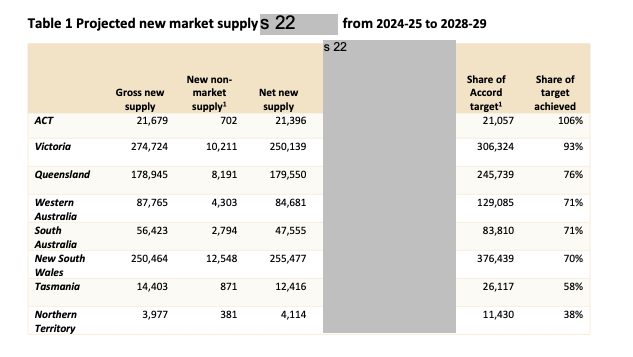
The ABC has reported that the Labour treasury has recommended that the target be adjusted and grants be reallocated.
1. Law and standards: policy initiatives are reflected in law, so compliance is not optional and remedies for failure can be accessed.
2. Prioritise the vulnerable: equality means helping those who need it most. That means resources are allocated to support those affected by natural disaster, released from prison, living with disability or under the legacy of discriminatory policy.
3. Whole-of-government: a coordinated effort spanning legislation, policy, development, tax, finance, planning, building, labour, environmental protection and resilience is needed.
4. Participation: let the people who need housing actually weigh in (not just be consulted) on decisions.
5. Budget and tax justice: budget allocations that meet the scale of the objective need to be set, with consequences for tax policy that are designed to deliver those budgets, even if it calls for cutbacks to negative gearing or capital gains relief.
6. Goals and timelines: set real measurable targets for process, outcomes and structural achievements, like SDG 11’s promise of safe, affordable homes for all by 2030.
7. Accountability: independently tracked, or it didn’t happen.
8. Access to justice: make sure people can use simple claims mechanisms when things go wrong, and use that feedback to plan systemic change.
9. Private sector rules: landlords and developers have human rights obligations.
10. Global teamwork: borrow ideas from places doing it better and prioritise housing adequacy above the incentives that typically encourage foreign capital to flow into residential real estate.